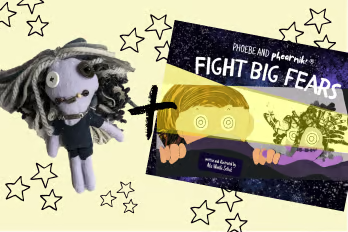
How to Overcome Blank Canvas Syndrome: A Way for Artists to Start Creating with Confidence

Overcome Blank Canvas Syndrome

There’s an unmistakable moment for every artist: standing before a blank canvas, feeling equal parts excitement and uncertainty, a need to overcome blank canvas syndrome. You may have all the materials ready and creative ideas swirling in your mind, but somehow, taking that very first step feels overwhelming. It’s not the career launch that’s intimidating—it’s simply starting, making that initial mark, and facing the fear of the blank canvas.

A picture of a man with a fear of the blank canvas. He is sitting in front of a canvas on an easel scratching his head like he doesn't know what he's going to paint. The picture resembles a Norman Rockwell painting of himself in front of his canvas scratching his head. The picture helps illustrate a need to overcome blank canvas syndrome
Phoebe’s dad has blank canvas syndrome. From the picture book, “Phoebe and phearnik! Fight BIG Fears”

Ready to Begin Your Next Project but…

Is the dream of creating your next piece finally calling you to the studio? You’ve imagined the colors and shapes you want to use—maybe while juggling other responsibilities. You want to respect your creative impulse as you prepare, so you gather inspiration and sketch ideas on the side. Still, even after knowing your process, you find it difficult to break through the hesitation and make the first stroke.

Blank Canvas Overwhelm

Starting a new project can feel like staring up at a daunting mountain. The possibilities are endless, and yet the pressure to make something meaningful can be paralyzing. You want to choose the right subject, select the perfect palette, and let your unique voice shine through. But how do you move past that initial block and let creativity flow? The overwhelm is real.

Creating Your Art in “Chill”

Wouldn’t it be wonderful to approach your blank canvas with ease, in a “chill” state of mind? Picture yourself beginning each new project with confidence, trusting your instincts and embracing the unknown. You’d love to brush aside the doubt, knowing your creativity will lead the way.

The Fear of the Blank Canvas

I’m here to tell you: no matter how daunting that blank surface looks, you can move past the hesitation and create something beautiful. I was once the least likely person to take that first step, let alone call myself an artist. If someone as unlikely as me can start creating, so can you.

I was in the same place as you – that place of having a fear of the first step. I am an artist and a mental health educator. As an artist, I struggled with a “fear of the blank canvas” also known as the “blank canvas syndrome.” It is similar to writers’ block that many writers deal with – an inability to get started and get the words from their brain onto the page. For an artist, it’s about translating ideas onto their chosen medium.

Combating the Fear of Getting Started

A picture of the book "Big Magic" by Elizabeth Gilbert. The book helped me figure out a way to overcome blank canvas syndrome.

Because of this “fear,” I did a lot of reading about how to deal with it. I read book like Art and Fear, The Artist’s Way, Affirmations for Artists and other resources. But it wasn’t until I read Big Magic: Creative Living Beyond Fear by the Eat, Pray, Love author Elizabeth Gilbert that I finally had a breakthrough.  In Big Magic…, Gilbert offers a new way to confront fear. Instead of trying to ignore it or get over it or get rid of it, she suggests we accept and acknowledge fear and “travel with it” [my quotations] without giving it any control. I loved this idea.

Previously, much of the literature about dealing with fear suggested ignoring it or trying to “get over it.” I appreciated Gilbert’s fresh recommendation to not ignore it or try to get over it but to acknowledge fear. She suggests not necessarily embracing fear but to at least recognize it’s always there. In an oft repeated metaphorical vignette about a car ride, Gilbert says to take fear with you. This is what resounded with me that I could do things with fear by my side along for the ride without letting it take control.

A Way to Take Fear with You

But for me the concept wasn’t enough. I wanted an actual “something” to take with me. This “something” would represent my fear. It would remind me that fear is always there. I can acknowledge it but keep it tamped down and under control. Enter phearnik! The Courage Buddy.

phearnik! is a little rag-doll-like plush. The name phearnik! (pronounced fear-nick) means “little fear.” Small enough to take anywhere in a purse or backpack, the little purple plush reminds me that fear is always with me. I just don’t need to let it take control. Plus, a having a little fear helps us pay attention. Thus, helping to keep us safe.

The Courage Buddy opened up my ability to breakthrough my fear of the blank canvas and more readily start creating. Having the quirky plush by my side reminds me a little fear about what’s going on the canvas is okay. But it also reminds me not to let it take over and shut me down.

Having the Courage Buddy by my side helped me overcome blank canvas syndrome and made it easier to start creating. The quirky little plush serves as a reminder that it’s perfectly normal to feel a bit of fear about what I’m about to paint. But more importantly, it reminds me not to let that fear take over or stop me from putting brush to canvas.

A picture of the phearnik! the Courage Buddy plush, a small rag doll with a lavender body, a navy blue jumpsuit and a wild head of yarn for hair. It has big black eyes and a squiggly mouth. Funny, cute and a little bit scary. The plush helped me overcome blank canvas syndrome.
phearnik! the Courage Buddy

A phearnik!® Courage Buddy™: Supporting Every Artist with Encouragement

I aim to provide every artist facing blank canvas challenges with a phearnik! Courage Buddy. This cheerful plush serves as a gentle reminder that success begins by keeping fears in perspective and taking the first step beyond one’s comfort zone.

A prototype of phearnik! has been created, and I am currently awaiting a sample from the toy manufacturer. Upon completion, I intend to offer the plush for purchase in my Etsy shop, so individuals can acquire their own phearnik! Courage Buddy.

I’m also considering providing the plush free of charge to artists, writers, entrepreneurs, and both children and adults facing fears who need support. To achieve this, I may seek funding through crowdfunding campaigns or grants.

Let’s Stay Connected

I designed the Courage Buddy as a tool for myself and for other artists who sometimes find themselves frozen by fear before they even begin. If you ever hesitate before starting something new, this little plush could be the gentle nudge you need.

If this playful idea appeals to you and you’re looking for a bit of motivation to get your creative energy flowing, I invite you to stay connected with me and get the free Fear Less Toolkit!

Making Sense! Child Behavior Problems Solved

A Helpful Guide Gets Child Behavior Problems Solved

Child behavior problems solved? Yes! Here’s how –

Most parents don’t search for child development information when things are going smoothly. They search when their child is melting down, refusing to cooperate, acting aggressively, or pushing every limit — and they feel frustrated, discouraged, or unsure what to do next.

When behavior is challenging, it’s easy to wonder if something is wrong — with your child or with your parenting. One of the most helpful shifts I’ve learned over the years is this: many difficult behaviors are developmentally expected, even when they’re exhausting.

A picture of a parent talking on the phone holding an infant with a younger child holding on trying to get the parent's attention. This parent wants their child behavior problems solved.

That’s why I (more about me here) continue to rely on the NYS Office of Child and Family Services Child Development Guide — and why I created a simplified, easier-to-use version for parents, teachers, and caregivers.

Why I Made a Simplified Version of the Guide

The original NYS Office of Child and Family Services guide is an excellent resource, and in my version, Making Sense: Child Behavior Problems Solved, I:

  • Credit and link directly to the original publisher
  • Use Part 1 only, which focuses on developmental stages
  • Link each stage on the Contents page directly to its explanation, so readers don’t have to scroll

This makes it much easier for parents and caregivers to quickly look up the stage they need — especially in moments when behavior feels overwhelming.

How Making Sense! Helps When Children Misbehave or Frustrate Us

An illustration of a teen in a crowd of other teens. I also use it it show how teen behavior is included in the child behavior problems solved guide.
Peer pressure influencing a teen trying alcohol for the first time

What I appreciate most about the Making Sense… guide is that it doesn’t ask parents to simply “fix” behavior. Instead, it helps adults understand:

  • Which behaviors are typical at certain developmental stages
  • Why children may struggle with impulse control, emotions, or transitions
  • What parenting behaviors best support development at each stage

This understanding changes how we respond.

Instead of reacting with anger or punishment, parents can respond with structure, calm, and intention — because they know what their child is capable of right now.

A Real-Life Example — Connected Directly to Making Sense!

Imagine a young child who frequently has tantrums when it’s time to stop playing and move on to the next activity. In the moment, this can feel defiant or manipulative.

According to the Making Sense! guide, behaviors like this are often expected during stages when children:

  • Are learning independence
  • Have limited emotional regulation
  • Struggle with transitions and delayed gratification

The guide doesn’t stop at explaining the behavior — it also outlines recommended adult/parenting responses, such as:

  • Giving advance warnings before transitions
  • Keeping expectations simple and age-appropriate
  • Staying calm and predictable during emotional outbursts
  • Helping the child label emotions after they’ve calmed down

When parents follow these recommendations, the goal isn’t to stop the tantrum instantly — it’s to build the child’s emotional and self-regulation skills over time.

This shift helps parents think:

“This behavior fits this stage — and I know how the guide suggests I respond.”

That clarity reduces power struggles and helps parents feel more confident and less reactive.

A picture of the cover of "Making Sense: Child Behavior Problems Solved." The guide helps parents identify which developmental stage  their child lacks and parenting practices to get them caught up.

A Gentle Alternative to Punishment-Based Advice

So much parenting advice focuses on stopping behavior as quickly as possible. While limits are important, they are most effective when they align with a child’s developmental capacity.

This guide encourages adults to ask:

  • What skills is this child still developing?
  • Are my expectations realistic for this stage?
  • How can my response support growth rather than escalate behavior?

This approach is especially meaningful for foster and adoptive families. Children who have experienced trauma or instability may have missed developmental milestones, even if they are older chronologically.

The guide allows caregivers to:

  • Identify which stages or skills were missed
  • Understand the behaviors connected to those gaps
  • Support development by responding to the child’s developmental needs, not just their age

A Resource for Parents, Teachers, and Caregivers

Whether you’re a parent dealing with daily power struggles, a teacher supporting emotional growth in the classroom, or a foster or adoptive parent helping a child catch up developmentally, Making Sense! Child Behavior Problems Solved offers reassurance and direction.

It reminds us that behavior is communication — and that understanding development helps us respond with patience, confidence, and compassion.

Get Making Sense! Child Behavior Problems Solved

If your child’s behavior is leaving you feeling confused or frustrated, Making Sense! Child Behavior Problems Solved can help.

Use it as a quick reference when behavior feels hard. Instead of guessing how to respond, you can look up your child’s developmental stage and feel more confident about what they need from you right now.

Understanding development doesn’t remove challenges — but it does replace self-doubt with clarity.

How to Build Courage to Stop Fears

Why I Made phearnik! The Courage Buddy and Who It’s For

Tired of Being Fearful

Are your fears tiring you out? Does your anxiety run you ragged? Additionally, do you see others doing simple, everyday things that you feel you want to do but you’re unable to? Would you like to stop fears from getting in the way of your joy?

If your answers are “yes,” it’s safe to say, you don’t like these feelings. They make you feel like such a weakling. You’re embarrassed and you’re exhausted.

Illustration by aws Studios showing a skinny woman with wild hair sitting in a short red dress looking very scared about something.

Towards Courage

It would be nice to stop fears from interrupting your life. Moreover, you would love to not be afraid of doing things others do as a matter of fact. Being more courageous is on your list. All of this would make you feel more free. You want to be released from the heavy cloak of fear. It’s a cloak that holds you back from doing things with ease and joy.

Something to Build Courage

If you relate, I have something for you. I made it especially for you. It’s something that can help you be more courageous and stop fears. It will help you step out of your comfort zone. With this special something, you will learn to not to be afraid. And, you too will do things with ease you see others doing . This “thing” will give you freedom. It will release you from the heavy cloak of fear you wear. Additionally, it will get you doing things you were once fearful of. And you will begin living your life with more ease and joy.

Courage Building Plush

Believe it or not, this “something” is a plush. Yes, a plush or a little stuffed novelty toy like the new LaBubu, the old Beanie Babies, or the popular Squishmellows. But my “something” plush was designed to be more than just a novelty or toy or favorite huggable. My “something” plush helps people who struggle with, the sometimes daily, non-life-threatening irrational fears. My plush helps these people fear less. The “something” plush I created is a phearnik!® or Courage Buddy™.

phearnik!® The Courage Buddy

The phearnik!® Courage Buddy is a small, soft purple plush with wild hair that looks like a ragdoll. I created phearnik! for myself. I believe others can benefit from using a phearnik!® too.

I created phearnik!® to help me build courage to stop fear. As a kid, I struggled with fears that seemed irrational compared to other kids. I was afraid of swimming in the ocean but saw other kids doing it and having fun. I was often afraid of joining in and playing with other kids standing on the side lines unable to leave my mother.

A picture of the phearnik! the Courage Buddy plush, a small rag doll with a lavender body, a navy blue jumpsuit and a wild head of yarn for hair. It has big black eyes and a squiggly mouth. Funny, cute and a little bit scary.
phearnik! the Courage Buddy

A Desire to Stop Fear

As an adult and artist,  I struggled with a “fear of the blank canvas.” This is like “writers’ block” that many writers experience. It is a fear of the “blank page.” The feeling overwhelms the artist or writer so that it’s difficult to get started, to get words on the page or paint on the canvas.

Also, as an adult, I spent a lot of time researching and reading about how to deal with this debilitating fear. I was not alone as the books I read suggested others needed help with this issue too.

The Answer in Big Magic

But it wasn’t until I read Elizabeth Gilbert’s (of Eat, Pray, Love fame) book, Big Magic: Creative Living Beyond Fear that I finally discovered  a way to move beyond my fear. An idea Gilbert presents in the book finally lead me to unburdened and joyous creating.

In the book, Gilbert suggests the artist accepts their feeling of fear. She points out that fear is always with us sometimes in full control and other times silent. Instead of trying to “get over fear” or ignoring it, Gilbert suggests we acknowledge fear. But, and it’s a big “but”, not let it take control of what we are trying to do.

Beyond Big Magic

As the story goes (I’ve written about it here and here), I loved this idea of accepting and acknowledging fear but not letting it take control. But I wanted to go one step further. I wanted to have an actual fear. I wanted an actual item that I could hold. if needed I wanted something I could take with me. Because of this, it needed to be small – small enough to fit in a purse or backpack or even a pocket. Hence, phearnik!®The Courage Buddy was born.

How the phearnik!®Courage Buddy™ Works to Build Courage and Stop Fear

The little plush acts as a prompt to remind individuals to keep fear small. This helps people be safe while stepping out of their comfort zone to do new things that are desired or needed to do.

phearnik! is a technique to reduce fear. I made it for both kids and adults. It’s for kids and adults who are a bit neophobic or unsure of trying new things. These individuals  could be overly cautious, shy, or timid. Or they could often experience feeling overwhelmed, unsure, or hesitant. I often use the terms fearful and anxious when describing who the Courage Buddy is for.

phearnik! is a fun way to practice and acquire a mental health or social emotional skill. Using the little plush helps the user remember to practice mindfulness during times of anxiety causing action.

I made phearnik!® the Courage Buddy for both kids and adults who struggle with:

  • Neophobia – unsure of trying new things
  • Being overly cautious, shy, or timid
  • Feeling overwhelmed
  • Consistently feeling unsure or hesitant
  • Non-life-threatening fears
  • Anxiety

Join the phearnik!®Courage Buddy™ Campaign

The phearnik! Courage Buddy Campaign works not only to help people understand what the plush is and how it works but to also build awareness to the importance of mental health skills and social emotional learning. When we learn social and emotional skills, we positively impact the prevention of mental illness and mental health disorders.

Support Mental Health

By participating in the Campaign, you demonstrate your commitment to supporting mental health. More specifically, it reflects your endorsement of the value in developing social and emotional skills, which are fundamental in preventing mental illness and related conditions.

Picture of a small, sad boy hugging their mom.

Get a Courage Buddy!

Joining the Campaign also contributes to making the therapeutic plush accessible to individuals of all ages who experience fear and anxiety. Additionally, as a subscriber, you will receive updates regarding the availability of the plush. To join, click the button below!

for more about the courage buddy, Read “Why I made “Phoebe and phearnik!®: Fight BIG Fears” picture book“

Looking for members – join the Courage Builders Facebook Group.

Overcoming Barriers to Launching Your Small Business 

Ready to Start Your Small Business but…

Is the dream of running your own business finally becoming a reality? You have read a lot about what you need to get started. Maybe you are still working in another job. You want to be cautious about your start-up. So, you work on it on the side. But, even after knowing what you need to do, you’re unable to take those first steps. There are barriers to launching your small business.

Small Business Start-up Overwhelm

Getting a small business off the ground is a lot of work. First you need a business name. Then you need to decide what type of business to set up like a limited liability company / LLC or some other entity. Additionally, you need to set up a website. And if you are selling online, you need to create sales funnels. Then comes the marketing. This is when you try to get the public to know about you – your product or services. All of this before having to deal with shipping and taxes! And how are you going to do that ?? It’s overwhelming, to say the least.

Small Business Start-up in “Chill”

Wouldn’t it be nice if you could plug away at your business idea in “chill”? It would be great to take each step as they come, one at a time, with confidence. You would love to approach each task knowing and feeling that, yes, you can do this – even shipping and taxes!

The Fear of Getting Started

I’m here to say, even with all the work and steps and tasks, you can do it. I am probably one of the most unlikely people to start a small business. If an unlikely specimen like myself could do it, so can you.

I was in the same place as you – that place of having a fear of taking that first step. I am an artist and a mental health educator. As an artist, I struggled with a “fear of the blank canvas.” This is similar to writers’ block that many writers deal with – an inability to get started and get the words from their brain onto the page. For an artist, it’s the struggle of putting the ideas in their head with paint onto a canvas.

A picture of a man with a fear of the blank canvas. He is sitting in front of a canvas on an easel scratching his head like he doesn't know what he's going to paint. The picture resembles a Norman Rockwell painting of himself in front of his canvas scratching his head.
Unable to get started

Combating the Fear of Getting Started

Because of this “fear,” I did a lot of reading about how to deal with it. I read books on the subject like Art and Fear, The Artist’s Way, Affirmations for Artists and other resources. But it wasn’t until I read Big Magic: Creative Living Beyond Fear by the Eat, Pray, Love author Elizabeth Gilbert that I finally had a breakthrough.  In Big Magic…, Gilbert offers a new way to confront fear. Instead of trying to ignore it or get over it or get rid of it, she suggests we accept and acknowledge fear and “travel with it” [my quotations] without giving it any control. I loved this idea.

Previously, much of the literature about dealing with fear suggested ignoring it or trying to “get over it.” I appreciated Gilbert’s fresh recommendation to not ignore it or try to get over it but to acknowledge fear. She suggests not necessarily embracing fear but to at least recognize it’s always there. In an oft repeated metaphorical vignette about a car ride, Gilbert says to take fear with you. This is what resounded with me that I could do things with fear by my side along for the ride without letting it take control.

A Way to Take Fear with You

A picture of the phearnik! the Courage Buddy plush, a small rag doll with a lavender body, a navy blue jumpsuit and a wild head of yarn for hair. It has big black eyes and a squiggly mouth. Funny, cute and a little bit scary.
Current version of phearnik!® The Courage Buddy

But for me the mere concept wasn’t enough. I wanted an actual “something” to take with me. This “something” would represent my fear. It would remind me that fear is always there. I can acknowledge it but keep it tamped down and under control.

Enter “phearnik!® The Courage Buddy”

phearnik! is a little rag-doll-like plush. The name phearnik! (pronounced fear-nick) means “little fear.” Small enough to take anywhere in a purse or backpack, the little purple plush reminds me that fear is always with me. I just don’t need to let it take control. Plus, a having a little fear helps us to pay attention. This helps to keep us safe.

The Courage Buddy opened up my ability to breakthrough my fear of the blank canvas and more readily start creating. Having the quirky plush by my side reminds me a little fear about what’s going on the canvas is okay. But it also reminds me not to let it take over and shut me down.

What’s This Got to Do with Starting a Small Business?

For me, everything. aws Studios is where I sell my mental health/social emotional learning resources and art online. When I wanted to transition these hobbies into a small business, I experienced a fear of getting started. I worried about taking those first steps. I knew what needed to be done but it all felt so overwhelming. How was little old me going to get the NY state government to give me an LLC? How was I going to sell my mental health resources and art online? And how was I going to tackle shipping and taxes?!

The Courage Buddy to Remind You

Just like breaking through my “getting started painting” fears, my Courage Buddy reminded me to keep my fears of starting a business small – oh, so very small. By doing this, I was able to take those first steps. I applied for an LLC with the state of NY. Scary! I also applied and received a registered trademark for phearnik!® Also scary especially when you’re doing it all by yourself! And phearnik!® helped me set up two online stores. Full disclosure, I’m still struggling to better understand shipping and taxes! I’m confident phearnik! will get me through those hurdles too.

This is a picture of the original phearnik! Courage Buddy plush that helps fearful kids and adults fear less. It is 6" with an off-white body made of cotton fabric, wears a green dotted dress, sports a head of wild hair made of yarn and a face made with buttons and beads.
The first phearnik! prototype

A phearnik!® Courage Buddy™ for Every Entrepreneur

Here’s my wish – every would-be-entrepreneur has a phearnik!® Courage Buddy. The fun little plush will help remind them that “you can do it!” By keeping fears small and taking a baby step out of your comfort zone – like learning how to get an LLC or open an online store – you can slowly and confidently get the tasks done that move you to opening day (maybe hold off on the shipping and taxes for now)!

How to get your own phearnik!® Courage Buddy

This image represents "The phearnik! Campaign Roadmap." It shows what aws Studios plans to do over the course of the year to make the plush available for fearful kids and adults who want to build courage.
The phearnik! Campaign Roadmap

The opportunity to own your own Courage Buddy is in the works. I want to make the plush available in my Etsy and Amazon shops for people like yourself and others like writers with writers’ block and artists with a ‘fear of the blank canvas’ to be able to have their own phearnik! Courage Buddy.

Currently, I am waiting to receive a sample of the plush made by a toy manufacturer. In the meantime, if you would like to follow the Buddy’s journey to the market, join the phearnik!® Courage Buddy Campaign. By signing up for the Campaign, I will keep you abreast of when you can own your own fear less phearnik!®

The 4 Phases of phearnik!®- The Fear Less Plush

Why phearnik!®- the Fear Less Courage Buddy

I created the phearnik!® (pronounced “fear nick,” meaning “Little Fear”) Courage Buddy plush to help me fear less and manage my anxiety. The character started out with a face of buttons and beads. Over the past four years, it has gone through four transformations—each one showing a new stage in its development. Now, it’s changing once again.

The 4 Phases of phearnik!®, the Courage Buddy Plush

Phase 1 of the Fear Less Plush

Here’s how the very first ” fear less” Courage Buddy plush came to life: I drew a pattern for its head, body, and long, skinny arms and legs. Using some beige cotton fabric I had on hand, I cut out the pieces and sewed them together. For its signature wild hair, I used yarn, and I added button eyes and a beaded mouth to give it a look I imagined as “funny ugly” or “scary cute.” I believe I captured that playful spirit.

This is a picture of the original phearnik! Courage Buddy plush that helps fearful kids and adults fear less. It is 6
The original phearnik! Courage Buddy plush

Courage Buddy Phase 2

A picture of a little girl holding her phearnik! Courage Buddy. The plush helps her overcome her fears so she can join in and have fun.
Phase 2 lavender phearnik!

Subsequently, I wanted phearnik!® to feel even more inclusive, so I made it more gender and race neutral in the next phase. The body changed from beige to a soft, flannel-like lavender, and the dress swapped for a navy jumpsuit. To add a bit of flair, I gave the “fear less” phearnik!® an necklace made from a baby’s ID bracelet, proudly showing its name.

Phase 3 of the Courage Buddy

Along with growing interest in the “fear less” Courage Buddy, I made three copies for close friends and family. In addition, I realized that my sewing each plush was not sustainable. To make it more accessible and affordable, phearnik!® became smaller, and the detailed button-and-bead face swapped for a painted version.

The body fabric switched to felt, and the eyes and mouth painted with acrylics. Clearly, feedback from toy industry professionals highlighted concerns that this version appeared too scary for young children. Furthermore, this prompted further revisions for the next phase.

A picture of Phase 3 of the phearnik! Courage Buddy plush.
Phase 3 phearnik! – Indeed too scary but still has an ID necklace

Phase 4

For Phase 4, I revisited the Phase 2 version of phearnik!® but made strategic adjustments to prepare for manufacturing. The plush’s necklace became too expensive to produce at scale. I replaced it with the phearnik!® logo displayed directly on its jumpsuit. The doll’s facial features also shifted from painted details to embroidered ones, enhancing both durability and consistency for mass production.

A picture of the phearnik! Courage Buddy plush prior to getting turning lavender.
Original phearnik! preparing for transformation
Ready for its dye bath
A picture of the Phase 4 phearnik! Courage Buddy.
phearnik! transformed once again

To streamline the prototyping process, I opted to modify the original plush rather than sew a brand-new one. I dyed the original off-white body to lavender and dressed it in the navy jumpsuit. Then I added the logo using iron-on transfer paper. I sent the manufacturer a photo illustration of the new embroidered face design. But I’m keeping the classic button-and-bead face for my personal collection,

Multiple Phases — A Common Practice

It’s common for inventions to evolve through several phases and prototype iterations. Reflecting on the journey, each stage of the “fear less” plush brought meaningful improvements. Although I enjoyed refining each version, the prospect of producing multiples by myself was daunting. This drove my push toward a manufacturable design.

Another Phase for phearnik!®- the Courage Buddy

Last year, I began researching the requirements for large-scale plush manufacturing—a story for another time. Meanwhile, phearnik!® continues to evolve. I’ve sent detailed specifications to an overseas toy manufacturer and am currently awaiting a sample plush based on those instructions. This sample will reveal how the final manufactured version of phearnik!® will look.

Once I receive the finished sample, I’ll share the results and updates on the “fear less” Courage Buddy’s ongoing transformation right here.

A picture of the phearnik! plush, a small rag doll with a lavender body, a navy blue jumpsuit and a wild head of yarn for hair. It has big black eyes and a squiggly mouth. Funny, cute and a little bit scary.
Phase 5 phearnik! for manufacturing

Celebrate Grandparents Day with a Story and a Pocket Full of Memories

Grandparents Day: September 7th

Grandparents Day is definitely more than a date on the calendar—it’s a chance to slow down, share family stories, and strengthen the bonds between generations. Besides what better way to celebrate than with a heartfelt picture book and activities that spark connection?

That’s exactly what a new aws Studios picture book Lucy’s Pocket offers.

About the Book

Fia never met her great-grandmother, Lucy. Nevertheless, thanks to her grandmother Alis’ stories, she learns about a woman who followed her creativity, adapted when life changed course, and always carried a spark of joy.

A picture of a page from the picture book "Lucy's Pocket" showing a woman getting her hair done at a salon.
Page from “Lucy’s Pocket”

In the beginning, Lucy dreamed of art school, but when that wasn’t possible, she attended beauty school instead, becoming the most beloved hairdresser at the Vanity Salon. One day, she treated herself to a beautiful fur coat—a coat that would quietly witness decades of family history.

A picture of a page of text from the picture book "Lucy's Pocket." A great Grandparents' Day book or gift.
Excerpt from “Lucy’s Pocket”

Through marriages, children, and years tucked away in closets, the coat became a treasure trove of memories. Eventually, it was transformed into pillows for Lucy’s children and granddaughter Fia—who received the pillow with the coat’s pocket. Now Fia carries her own mementos everywhere, adding her chapter to the family story.

Perfect for Grandparents Day

This story celebrates family legacy, creativity, and the power of shared memories—themes that feel especially meaningful on Grandparents Day.

  • As a gift: Grandchildren can give the book to their grandparents as a shared reading experience.
  • As a memory-spark: The coat’s journey inspires families to talk about their own heirlooms, traditions, and special keepsakes.
  • As an activity: The companion Reading Guide helps parents, homeschoolers, and teachers bring the story to life with creative, hands-on projects.

About the Reading Guide

The Reading Guide for “Lucy’s Pocket” includes:

  • Discussion prompts to spark conversation about family history, keepsakes, and creativity.
  • Hands-on activities like making a “memory pocket” pillow, drawing family memories, and creating Grandparents Day cards.
  • Games like “What’s in the Pocket?” to make the concept of mementos interactive and fun.
  • Craft extensions such as “Yarn Curls” inspired by Lucy’s salon days.

These activities are simple to set up, work well for ages 4–6, and can be adapted for classrooms, homeschool settings, or family gatherings.

For Parents & Homeschoolers

  • Encourage your child to ask their grandparents about the objects in their home—every heirloom has a story.
  • Use the “memory pocket” activity to help children understand the importance of preserving special moments.
  • Read the story together over video call if grandparents live far away, then share the completed crafts by mail.

For Teachers

  • Incorporate the book and guide into a Grandparents Day celebration at school.
  • Invite grandparents or older relatives to visit and share their own family stories.
  • Display children’s “memory pocket” projects in the classroom to spark conversations about heritage.

A Gift That Connects Generations

Whether it’s wrapped with a handmade card or paired with a craft from the reading guide, “Lucy’s Pocket” isn’t just a gift—it’s a way to create and share lasting memories.

This Grandparents Day let’s celebrate the stories that live in the objects we pass down, the memories we keep in our pockets, and the love that ties generations together.

What about you? We would love to hear about your stories of your grandparents or great grandparents

Read about how I used clip-art for the book’s illustrations!

5 Scenarios that Help with Fears

Transform Fearful Kids and Adults to Fear Less

C’mon. How Does This Thing Work?!

I want you to know how the phearnik!® plush works to help with fears and transform fearful kids and adults to fear less.

I’ve told you about phearnik! — what it is and how it works. I’ve given you some proof of its effectiveness and how and why I created it in the first place. But I want to provide you with more examples of how phearnik!® can help with fears and transform fearful kids and adults to fear less.

A picture of the phearnik! plush, a small rag doll with a lavender body, a navy blue jumpsuit and a wild head of yarn for hair. It has big black eyes and a squiggly mouth. Funny, cute and a little bit scary. The plush helps fearful kids and adults transform to fear less.

phearnik!® In Action

The following are “composite-style” scenarios, realistic situations drawn from known research on anxiety, mindfulness, exposure, and comfort objects. These scenarios show how people of all ages can put the cute and quirky little plush into action. This, then, helps to ease anxiety and build courage.

Support the phearnik!®  Campaign

After reviewing these scenarios, let me know if they have enhanced your understanding of how phearnik! works. If you see value in this product, consider supporting the phearnik!® Campaign. By doing so, you will be among the first to be notified when the plush becomes available. In addition, you will be contributing to help with fears and transform fearful children and adults to fear less.

phearnik! Scenarios

Building self-trust: “I did it — even though I was scared.”

A picture of a little girl holding her phearnik! The plush helps her transform her fears to fear less.

Dena, age 7, hated trying anything new. Even playdates at a different house made her stomach hurt. Her mom started reminding her to hold her phearnik!®, take slow breaths, and repeat “small fear keeps me safe, big fear makes me freeze.” Over a few months, Dena was able to join a new art class — still nervous, but she noticed, “I can be a little scared and do it anyway.” This is exactly how children build self-efficacy, a core idea from Bandura’s research: learning they can act despite fear.

Developing a calm inner voice: replacing harsh worry with soothing reminders

Liam, a college student, used to spiral with thoughts before presentations like “What if I mess up? What if everyone thinks I’m weird?” Keeping phearnik!® nearby gave him a tactile anchor (a proven grounding technique). Each time he thought of it and breathed out slowly, he practiced saying, “It’s okay to be nervous but I can still handle this.” Over time, that became his automatic self-talk — a shift well-documented in cognitive behavioral therapy studies.

Learning to separate feeling from fact: “Scared doesn’t mean stop.”

Faith, a middle school teacher, brought phearnik!® to her classroom for her students to use. But she ended up using it herself before presenting at meetings. She found it helped her notice: “My fear of presenting in front of my colleagues is uncomfortable, but it isn’t dangerous.” Having the plush around reminded her to pause, breathe, and choose action. This is tied to well-established mindfulness work (Kabat-Zinn) which shows mindfulness helps people observe emotions without over-identifying with them. More here.

A picture of a woman on stage presenting to a large seated audience. The woman presenting at a podium is looking back at the viewer of this picture with her hand on her phearnik! plush that helps her manage her fear of presenting in front of a large audience. The plush helps with fears and transforms the fearful adult to fear less. The plush reminds her to stay calm and keep her fear small and not freeze so she can do the presentation.

Becoming more willing to try new things: gentle exposure with a comfort cue.

Andrew, 4, wouldn’t go near the big slide at the park. His dad started bringing phearnik!® along, encouraging Andrew to pet its soft hair, take a deep breath, and look at the slide. Week by week, they got closer. Eventually, clutching the little plush tight, Andrew went down, loved it, and wanted to do it again. This follows a key principle of exposure therapy: small, supported steps with a comforting object reduces avoidance and builds courage.

Regulating the body faster after fear: soothing the nervous system

A black and white pen and ink drawing of a young girl looking fearful, nervous or scared. The picture is used to help illustrate how the phearnik! plush helps with fears and transforms fearful kids and adults to fear less.

In one study on transitional objects, children hugging a favorite toy had reduced cortisol spikes during stress (source: Passman, 1977). Similarly, Jamie, a teen, kept a phearnik!® in her backpack. During times of feeling anxious, she would reach in and stroke its soft body and hair while breathing slowly. This helped settle her racing heart, letting her return to class instead of going to the Nurse’s Office.

Building Courage Through Mindful Support

In moments of fear, doubt, or uncertainty, having tools like phearnik!® can make a world of difference. Whether it’s for children learning to trust themselves, students calming their inner critic, or adults navigating daily challenges, small visual and tactile prompts can empower us to act with courage. Building resilience doesn’t happen overnight, but with mindful practices and gentle supports, we learn to shrink big fears and expand possibilities — one brave step at a time.

This image represents "The phearnik! Campaign Roadmap." It shows what aws Studios plans to do over the course of the year to make the plush available for fearful kids and adults who want to build courage.

The phearnik! Campaign

So, what do you think? Did these stories help you better understand how the little plush works? If so, consider supporting the phearnik!® Campaign. Be among the first to know when the plush becomes available, all while supporting the phearnik!® movement — to help with fears and transform fearful kids and adults to fear less!

Thanks for reading!

This is a picture of Alis Wintle Sefick, the owner/operator of aws Studios and her signature.

Understand Your Teen

A Free Tool to Help you Understand Your Teen and

Strengthen Communication and Connection at Home

Raising a teenager today means navigating a whole mix of personalities, emotions, and communication styles. You may have noticed that what works for one of your kids—or one of their friends—completely backfires with another. That’s because teens, like adults, all have different social styles. You need help to understand your teen.

If you’ve ever wondered why your teen shuts down during serious talks, thrives on connection, or insists on structure and logic, this free resource can help.

An abstract graphic of a teenaged girl with red hair and earrings. She depicts a teenager who's parent would like information about raising adolescents like understanding the teen's social style.

Why Social Styles Matter for Parents

Understanding your teen’s social style can transform the way you connect with them. Whether you’re helping with homework, working through a disagreement, or just trying to talk about their day, getting help to understand your teen and knowing how they naturally communicate and process information can make a huge difference.

When you understand how your teen is wired socially and emotionally, you’re better able to:

  • Build stronger, more open relationships
  • Minimize arguments and misunderstandings
  • Support their growth in ways that feel authentic to them
  • Foster a calmer, more respectful home environment

Get the Free Social Styles List

This free Social Styles List gives you a simple breakdown of the four main social styles commonly seen in teens:

  • Drivers – Focused, direct, and independent. They like goals and clear expectations. Learn how to guide them without clashing.
  • Amiables – Loyal, friendly, and harmony-seeking. Discover how to support them with emotional safety and patience.
  • Expressives – Energetic, imaginative, and outgoing. Find ways to channel their enthusiasm and help them stay focused.
  • Analyticals – Detail-oriented, logical, and thoughtful. Learn how to communicate in ways that make sense to them and avoid unnecessary tension.

Each style comes with insight into how your teen might respond in different situations, and tips for supporting them based on their unique traits.

This Freebie Is a Sneak Peek Into a Bigger Picture

The Social Styles List is part of my Circle of Community program—a resource originally developed for educators that parents are now finding incredibly helpful, too. It offers simple strategies that promote empathy, reduce friction, and strengthen emotional connection.

Helping Teens Communicate in a Post-Pandemic World

Let’s face it—today’s teens are growing up in a time of intense social and emotional change. Many are still recovering from the isolation and disruption caused by the pandemic. They’re figuring out how to relate to others while navigating growing independence, academic pressure, and big feelings.

This free list helps you better understand how they interact, what motivates them, and how to encourage healthy communication—skills they’ll use for life.

Ready to understand your teen better?

Get the Social Styles List for free here and start building stronger connections at home, one conversation at a time.

Want even more tools like this? My Circle of Community resource offers deeper insights and simple activities to help you foster communication and emotional growth in your teen.

The phearnik!® Crowdfunding  Campaign

The phearnik!® Campaign

A month ago, I announced my campaign to make phearnik!® available to every child who could use its subtle powers. These “powers” work to support children’s mental health. In particular, the quirky little plush helps kids be less scared of everything.

A Crowdfunding Project

To help me make the plush available in the marketplace, I plan to launch a fund-raising campaign later this year. The funds raised will help me with manufacturing costs. These include the manufacture of the phearnik!® plush and the printing of the accompanying Phoebe and phearnik!® Fight BIG Fears picture book.

A picture of a bookmark that says "Support Mental Health, Join the phearnik! Campaign" with a QR code to sign up.

Why Crowdfunding?

For my phearnik!® Campaign, I am using “crowdfunding.” Crowdfunding is a way to fund projects by raising money from a large number of people through the internet. Many artists and entrepreneurs have successfully raised funds and fostered awareness of their initiatives through crowdfunding.

Like these artists and entrepreneurs, I have invested my own funds into my project, along with the support of family and friends. To take my idea to the next step, I need more help. I want to branch out to include others who are also interested in supporting mental health.

An example of a “Reward”- a plush with a book
This Reward is the same with a T-shirt

Kickstarter Crowdfunding

For my crowdfunding campaign, I am using Kickstarter. Kickstarter is one of many online crowdfunding platforms. These platforms make it easy for creators to share their projects and receive funding. With Kickstarter, like similar platforms, investors or “backers” receive rewards for their investment.

I chose Kickstarter because I like the fact that, to receive funds from your backers, you must meet your funding goal. If you do not meet your goal, your project does not receive any funds. Plus, backers would not be expected to pay. Although challenging, this seems fairer for the investor.  A creator who reaches their goal is more likely to follow through with their initial intentions than those who do not.

Mental Health Issues on the Rise

Kids’ mental health issues are on the rise in the US and around the world. Many suffer anxiety and are hamstrung by their fears. These include irrational fears like being afraid of the water, going to a new school or getting a shot at the doctors. Furthermore, kids often lack the skills needed for their social and emotional learning. Parents of these children are frustrated and request more tools and strategies to help them help their kids.

Hear what Rebecca, a retired Pre-school Educator, had to say about phearnik!®:

“My now grown daughter could definitely have used a phearnik doll. She was very fearful of new things to the point that it affected her social connections with other kids her age. At the time there was no product like phearnik on the market. We relied on tiny “worry dolls“ to help her manage her fears. I definitely would have invested in phearnik had it been available at the time. I think it would’ve been a big help to her then.”

Support Children’s Mental Health

By supporting the phearnik!® Campaign, backers will be an essential link to bringing this mental health resource to fearful children and their parents. In addition, investors will be sponsoring the larger mission of “boosting” or supporting mental health. With the phearnik!® Campaign, this includes the message of reducing mental health issues with skill building aka social emotional learning (SEL).

What About You?

What have you used to help kids with their anxiety? In what other ways do you support mental health? Let us know in the Comments.

If you’re inclined, give this post a “Like!”  Support mental health, share this post with others.

Trix Are For Kids! But phearnik!® is Not (just for kids)

Adults and Irrational Fears

Previously, I wrote about phearnik!® and how to use it with kids. In addition, the little plush also helps adults overcome irrational fears and anxiety.

In the US, nearly 20% of adults deal with irrational fears and anxiety. Treatment often involves exposure therapy and cognitive behavioral therapy (CBT) which helps individuals gradually confront their fears and learn coping mechanisms. These include relaxation techniques, exercise, support from friends or professionals and practicing mindfulness. [Google AI]

The  phearnik!® plush provides a way to practice mindfulness. Also, I didn’t make it for kids. I made it for an adult…me!

Fear Of The Blank Canvas

A picture of a man with a fear of the blank canvas. He is sitting in front of a canvas on an easel scratching  his head like he doesn't know what he's going to paint. The picture resembles a Norman Rockwell painting of himself in front of his canvas scratching his head.
Collage illustration from the “Phoebe and phearnik! Fight BIG Fears” picture book

As an artist, I often dealt with a “fear of the blank canvas.” It’s like the “fear of the blank page” or “writers’ block” that some writers experience.

While it’s impossible to know the exact number of writers in the US who experience writer’s block or fear of the blank page, it’s a common experience, even for those considered successful. 

The same is true for artists. It’s impossible to put an exact number on how many artists in the US experience “blank canvas syndrome.” Still, it is recognized as a common experience among artists from newbies to seasoned professionals.

Overcoming Fear of the Blank Canvas

For years, I studied what I could do about my irrational fears and anxiety of the blank canvas. I read books like Art and Fear, Affirmations for Artists, and The Artist’s Way. But none of these helped me break through my debilitating fears until I read Elizabeth Gilbert’s “Big Magic: Creative living beyond fear.” 

Gilbert’s “… Road Trip”

In the book, Gilbert offers a new way for artists to confront their fears. Instead of trying to ignore it or get over it or get rid of it, she suggests we accept and acknowledge fear. In a vignette titled, “The Road Trip,” Gilbert uses the metaphor of taking a road trip as a lesson in acknowledging fear.

A picture of a man driving a car with a girl holding her doll in the backseat with a phearnik! strapped in beside her. The phearnik represents fear sitting in the back seat as explained in "The Road Trip" by Elizabeth Gilbert.

On the trip, you bring fear along, but it must sit in the backseat. And it doesn’t get to control anything. It doesn’t get to drive, and it definitely doesn’t get to control the radio.

This idea of acknowledging fear but not letting it take control was, for me, revolutionary. I immediately embraced this new way to deal with my irrational fears. I liked the idea of  embracing fear. It makes sense because it’s always there. But it needs restraint. It needs to be kept  in its place, restricted, tamped down.

The Birth of phearnik!® 

An illustration from the "Phoebe and phearnik!® Fight BIG Fears"children’s book that helps kids overcome their fears.

I wanted something to represent this fear in “the back seat,” an actual “thing.” This “thing” would remind me to practice the skill of keeping fear “small” or in its place. It is how and why I created phearnik!®  –  my “little fear.” And it works.

phearnik!®  Works

My phearnik!® helped me with, not only my fear of the blank canvas, but as a way to practice mindfulness to overcome fear in other areas of my life. It has helped me do what I have needed to do to bring this concept to others. I believe artists and others who struggle to overcome their irrational fears would benefit from a reminder to keep their fear under control. I believe this could help them live more fearlessly while experiencing new things and adventures.

How About You?

Are you an adult dealing with irrational fears? Have you struggled with letting your fears get the best of you? Maybe you’re artist or writer that has experienced fear of the blank canvas or page? Or are you someone who would like to make art but you are afraid of what people would say about it?

If this is you, do you think a phearnik!® could help you remember to keep your fear “small” and in its place? Do you think having the little plush around could help you fight your fears? Tell us what you think about it in the Comments.

Want To Know More?

If you would like to know more about phearnik, join the phearnik! Campaign.

Help bring the plush to all who could use its subtle power!

If you’re inclined, give this post a “Like!” 

Share this post. You may help someone overcome their fears.

* Sources: Blank Canvas and Writers’ Block